Showing posts with label biodiversity. Show all posts

December 13, 2021

The Mind of Plants: Book launch by Synergetic Press on December 15

  --Synergetic Press has just released The Mind of Plants: Narratives of Vegetal Intelligence, edited by John C. Ryan, Patricia Vieira and Monica Gagliano, and with a foreword by Dennis McKenna. Here is the jacket blurb I wrote for the book:

From apples to Ayahuasca, from spinach to Xiang-Si, this wide-ranging collection serves up forty essays and fourteen poems that, each in its own singular voice, collectively meditate on how and why plants scratch, sting, enchant, nourish, illuminate, intoxicate and enslave us. The contributors—including biologists, ethnobotanists, chemists, physicians, anthropologists, philosophers, writers and artists from diverse cultural backgrounds—enliven the emerging field of study on plant intelligence by interweaving poetry, personal stories, scientific findings and spiritual insights, sometimes within the same entry. Authors Jeremy Narby and Prudence Gibson invite us to “vegetalize” our thinking as well as our writing, while Alex Gearin warns of the dangers of projecting human intentions onto the radical otherness that constitutes the plant mind, lest we “reckless sorcerers of the Anthropocene” leave the world a sadder place. Equal parts herbal manual and alchemical spell book, this beautifully illustrated volume will appeal to scientists, shamans and poets alike. 

Join the editors for a conversation on December 15th at 1 PM PST. 

-----


June 21, 2021

A wildcat doesn’t change its spots: Gold mining on Indigenous lands in Bolsonaro’s Brazil

A shootout on May 10 between Yanomami Indigenous people and heavily armed illegal miners in Roraima state, Brazil, left three miners and two Yanomami children dead. Since then, invaders have returned by boatloads, firing on community members and even Federal Police agents. Emboldened by Jair Bolsonaro’s election to the Brazilian presidency in 2018, wildcat gold miners have invaded federally protected Indigenous lands with impunity, knowing that the president has their back. 

Illegal mining on Yanomami lands has altered the course of rivers: photo Instituto Socioambiental

Bolsonaro has always had a soft spot for gold miners. During his presidential campaign in 2018, Bolsonaro bragged about driving around with a kit of sieves in the trunk of his car so he could stop whenever he wanted to pan for gold. “Mining is addictive, it runs in the blood,” he stated, referring to his father, Percy Geraldo Bolsonaro, who joined over 100,000 wildcat miners in the notorious gold rush at Serra Pelada in the Amazonian state of Pará in the 1980s. 

Bolsonaro's father participated in the "Hellish" devastation at Serra Pelada in the 1980s: photo by Sebastião Salgado

A year after winning the election, Bolsonaro invited miners from Serra Pelada to the presidential palace, reminiscing about “happier” times for miners during Brazil’s two-decade-long military dictatorship and making the widely criticized and crude remark, “Interest in the Amazon isn’t about the Indians or the f***ing trees. It’s about mining."

"It's about mining" 

Bolsonaro’s frequent derogatory comments about Indigenous land titling, his systematic rollback of environmental policing and his promises of a “blank check” for miners fueled a massive surge in illegal mining on Indigenous lands throughout Brazil, even as the coronavirus pandemic threatened vulnerable Indigenous populations. The invasion of the Yanomami Indigenous Lands by tens of thousands of illegal miners helped spread the Covid-19 pandemic, which has killed over 20 Yanomami people (out of a total population of 20,000) while increasing deforestation by 30% in just one year. 

Health studies among the Munduruku people of Pará state showed that 60% exhibited unsafe levels of mercury that has been introduced to the food chain by illegal miners. Nonetheless, Bolsonaro’s pro-business environmental minister Ernesto Salles has intervened in support of illegal mining operations in the region. More recently, Minister Salles has become implicated in an international investigation over illegal lumber exports from Brazil to Europe and the US.

Mining in Munduruku lands has fueled an epidemic of mercury contamination.

The Brazilian Constitution of 1988 does not forbid mining on Indigenous lands. Rather, it stipulates that mining will only be permitted after the passage of regulatory legislation by Congress, which would include congressional hearings with affected Indigenous communities and the formalization of agreements on benefit sharing. 

Even before Bolsonaro’s time, Indigenous communities in different regions had considered the possibility of sustainable mining projects. However, experiences with informal mining prior to Indigenous land demarcation highlighted numerous risks, while calling into question the ability of governmental agencies to carry out proper oversight. There are currently over 4,000 requests for mining concessions that would affect nearly a third of Brazil’s Indigenous lands if such legislation were to be passed.

As soon as Bolsonaro consolidated majority control over both of Brazil’s congressional houses in February of 2021, his government announced a list of legislative priorities that included the legalization of mining on Indigenous lands. Bolsonaro has met personally with minority pro-mining voices among some Indigenous communities in order to move this agenda forward.

Bolsonaro has met with Indigenous leaders to promote mining as an economic alternative

Even though Bolsonaro touts himself as a crusader for Indigenous peoples’ rights to benefit from the development of mineral and other resources on their lands, a recent comparative study of data from municipal authorities throughout Brazil has concluded that gold and diamond mining operations do not bring about lasting improvements to socioeconomic indicators, but rather “leave the region poor, sick and lacking in education”.

Growing criticisms of Bolsonaro’s mishandling of the coronavirus pandemic, which has killed over 500,000 Brazilians, has weakened his political position. An open admirer of former U.S. president Trump, Bolsonaro is also facing pushback from the Biden administration for his lax attitude towards deforestation and forest fires in the Amazon. 

Just before the Global Climate Summit in April, Bolsonaro wrote president Biden promising to end deforestation in the Amazon, apparently eager to cinch a billion dollar aid deal. Brazilian indigenous leaders warned Biden not to trust such disingenuous overtures. 

Bolsonaro and Salles announce measures to monitor deforestation

The economic devastation wrought by the Covid-19 pandemic in Brazil as well as Bolsonaro’s falling popularity in 2022 election polls put the Biden administration in a strong position to seek major concessions for any cash-for-conservation deal. High on that list should be reining in illegal incursions and withdrawing the legislative bid to legalize mining on indigenous lands.

After over a month of inaction from federal authorities, the Brazilian Supreme Court has finally mandated the immediate removal of illegal miners from Yanomami and other indigenous lands. It remains to be seen whether this judicial victory will bring about meaningful enforcement, or whether it will only further embolden president Bolsonaro and the wildcat miners he has so vociferously supported.

-----

This text is the full and updated version of my letter in Nature Correspondence, first published in abbreviated form on June 8.  


April 27, 2021

Unlikely Blessings: A poem on hope, despair and periwinkle

 This poem, written fifteen years ago as my youngest son began (thankfully successful) chemotherapy for a rare immune system disease, was recently published for the first time by Sapiens.

"Salvation can be danger thinly veiled"

Unlikely Blessings

Peace can be a sky-blue hospice with daffodils
a grave green lawn for innocents
bald and serene as Buddhist monks

Happiness can be written in Chinese
on a decal clinging to a jade bar of soap
at the visitors’ sink

Beauty can be simple and fragile as children laughing
the play of skin and shadow
under the unknowing sun

Fate can be exactly the size and shape of an olive
diagnosis or misdiagnosis
a surgeon squinting over a slide

Salvation can be danger thinly veiled
caustic milk of the periwinkle
halfway from malignant to benign

Faith can be a near empty chapel
waiting for you to get desperate enough
to sing with the others Ha-ha-hallelujah
Hope can be the worst kind of houseguest
hanging between the quick and the damned
counting unlikely blessings

-----

Listen to my reading of the poem at Soundcloud.

Learn more about the composition of this poem, and how it was inspired by the work of Paul Celan, at Sapiens.

See my previous blog post about my son's chemotherapy with vinblastine, a cancer-treating drug derived from traditional medicine: "Three Cheers for Periwinkle!"

Read the prize-winning poem "The Fish Trap" featured last year by Sapiens for World Poetry Day.

Read my coronavirus haiku, "Yellow Jessamine." 


July 27, 2020

"The Camera is our Weapon": Kayapó video warriors featured in new exhibit at the American Museum of Natural History in New York

The Kayapó (Mebengôkrê) people of Brazil are living proof of the resistance and adaptability of Indigenous cultures. A new exhibit at the American Museum of Natural History in New York highlights the dynamism and creativity of this warrior tribe, and their historical struggle to preserve their lands and culture. Originally inhabiting the dry savannahs of central Brazil, the Kayapó were pushed farther north and west by Portuguese invaders, ultimately moving into the Amazon basin hundreds of miles from their ancestral homelands. In order to survive in this new environment, the Kayapó had to conquer, capture and appropriate new lands, technologies and knowledge from their enemies and retool them for their own ends. The Kayapó people maintain this warrior heritage through the present day, as they have seized on video cameras, international media visibility and even "Kaya-pop music" to broadcast their voices and defend their culture.


Self-portrait of video warrior Bepunu Kayapó, July 2020.

The exhibit is centered on a striking self-portrait of Kayapó warrior Bepunu in full ritual regalia gazing back at the spectator armed with a video camera. This image creates a dialog with an existing exhibit case in the American Museum's Hall of South American Indians that contains a mannequin depicting a Kayapó warrior brandishing a traditional war club. During the course of creating the exhibit, I was able to locate Kubei, a Kayapó activist who had visited the American Museum in 1990 in the company of anthropologist Terence Turner. Kayapó film maker Pat-I recorded an interview with Kubei in March of 2020, especially for this exhibit, in which he reflects on his visit to New York 30 years ago, describes his reaction to meeting his Kayapó "friend" (his name for the mannequin) and responds to how Kayapó culture was displayed at the museum. 


Above: Kayapó activists Kubei and Tapiet visited the American Museum in 1990 and gifted their Kayapó "friend" with a feather headdress and other body ornaments that remain in the exhibit case to this day (photo: American Museum library). Below: the Kayapó warrior mannequin at the American Museum (photo: David Harvey). 

The exhibit was designed by a group of graduate students at Columbia University's Museum Anthropology program in collaboration with American Museum curator Laurel Kendall, exhibit designer David Harvey and other American Museum staff as part of an annual practical course that invites outside specialists like myself to help develop a new exhibit case every Spring. Because of the COVID pandemic, installation of the physical case was postponed, and instead we prepared an online version that includes a 3D virtual reality visualization of the actual exhibit case containing various Kayapó cultural objects. 


Virtual reality 3D visualization of the exhibit case

The online exhibit includes a series of short films made by Kayapó film makers, an activity booklet for children as well as information and donation links regarding the impacts of the COVID-19 pandemic on the Kayapó and other indigenous peoples of the Amazon. Playable audio files present the pronunciation of key Kayapó language terms and provide an example of the lively rhythms of "Kaya-pop" music. The exhibit also features images by photojournalist Dado Galdieri. A Portuguese translation of the exhibit website was prepared in a co-launch with the Goeldi Museum in Brazil:


Read our recent paper on Kayapó film-making in Current Anthropology 

Related stories from this blog: 


-----

Special thanks to Laura Zanotti, Janet Chernela, Pat-I Kayapó and Bepunu Kayapó for their invaluable contributions to this exhibit.  


June 4, 2020

Fifty Shades of Green: Reflecting back on the Oscar-nominated film Embrace of the Serpent in the age of coronavirus [excerpt]

The tragic death from coronavirus of indigenous actor Antonio Bolivar, star of the Oscar-nominated film Embrace of the Serpent, has made me reflect back on all the facts the film got wrong and the truths it got right: Excerpted from Chacruna.net 

As the lights in the cinema went down and the opening scene of Ciro Guerra’s 2015 film The Embrace of the Serpent began to flicker on the screen, I was primed to be blown away. The film, based loosely on the field experiences of legendary Amazon explorers Theodor Koch-Grünberg and Richard Schultes, and shot on location in the Colombian Amazon with indigenous actors, was being hailed as visionary. Within the first few seconds my already high expectations of ethnographic authenticity were already surpassed. In the opening sequence, the protagonist Karamakate, whose youthful self is played by Cubeo indigenous actor Nibio Torres, brandishes a long, slender spear that buzzes like a rattle snake when shaken. As a researcher and museum curator who has worked in adjacent regions of the northwest Brazilian Amazon, I have seen identical ceremonial rattle-spears in ethnographic collections and heard them deployed in rituals. 


Antonio Bolivar, the Ocaina indigenous actor who played the elder version of solitary shaman Karamakate in the film, died at the end of May from coronavirus in the jungle town of Leticia, Colombia.

Cinematic representations of the Amazon have a long and dismal history of exoticism, sensationalism and pure fantasy, from The Emerald Forest to Medicine Man to Anaconda. At last, a popular feature film that represents Amazonian peoples accurately! And yet instants later these admittedly high hopes were dashed. When the canoe containing the German explorer “Theo” (Koch-Grünberg’s pseudonym in the movie) gets closer to the bank, Karamakate pops off the spear’s rattle-tip to reveal a blowgun which he aims menacingly at the intruder. Though indigenous peoples of the Vaupes region indeed use blowguns with curare-tipped darts for hunting, I am not aware of any culture that combines these two pieces of material into a single, interchangeable multi-purpose weapon. “Sssssss”, began the hissing sound, not of a serpent but of my rapidly deflating enchantment...


Continue reading the full article at Chacruna.net

-----


March 23, 2020

Yellow Jessamine: A coronavirus haiku

Yellow jessamine
infects a premature Spring:
Fragrant and lethal.

Gelsemium sempervirens, known as yellow jessamine or Carolina
jasmine, 
is a toxic plant with alkaloids related to strychnine that 
figures i
the plot of an Agatha Christie mystery and an episode of House of Cards

March 23, 2020
Williamsburg, Virginia

-----

#CoronaHaiku at the suggestion of Daniel Mendelsohn

See also "The Fish Trap," winner of Sapiens.org anthropological poetry prize


February 15, 2017

Lessons from the Catwoman: Extinction and resilience of Amazonian fauna [exerpt from SAPIENS]

Francisco Evangelista, a Paumari Indian who grew up along the Piranha River within the Purus River basin in the Brazilian Amazon, tells a tale from his boyhood about a pelt hunter who went mad from his own excess. Speaking in backwoods Portuguese, Evangelista—who was raised by a rubber tapper whom he called patrão (“boss”)—recalls the day he and the patrão came upon this commercial hunter in distress.

“My boss found [the pelt hunter] on the river bank by a whole herd he had just killed, must have been 12 or 15 peccaries skinned and left to rot,” Evangelista recounts. “We had seen two more herds he had slaughtered a little farther up the river. He was crazy, scared, shaking, screaming about how the jaguars and peccaries were coming to get him because he had killed so many. We took him in our boat but he kept screaming and going crazier and crazier till finally he died, right in front of my eyes,” Evangelista says. “Our people know you can’t just go killing animals like that. It’s perverse. And the forest has its guardians.”

Hunting by local forest-dwelling people in the Amazon for subsistence and commercial purposes has long been considered by many conservationists to be a major threat to biodiversity conservation. In the 1990s, conservationists warned that unbridled hunting could result in “empty forests”—places where trees remain but large animals are eerily absent, hunted out by local people... But a recent study published in Science Advances analyzing historical data on commercial hunting throughout the 20th century tells a different story, showing that many terrestrial Amazonian species have proven more resilient than most experts expected... 


"The jaguar-fur suit worn by Catwoman in the 1966 film Batman: The Movie helped drive the trend..."
The international trade in Amazonian animal hides gradually increased after the collapse of the "Rubber Boom" in 1912, then experienced its first peak during World War II when the U.S. again sought wild rubber from the Brazilian Amazon after the capture of Malaysian rubber plantations by the Japanese. The influx of tens of thousands of rubber tappers meant more hunters in the forest taking advantage of a secondary income stream. The 1960s saw a second peak of Amazonian animal hide exports as exotic furs came into fashion in Europe and the United States. The jaguar-fur suit worn by Catwoman in the 1966 film Batman: The Movie helped drive the trend...

At least 23 million wild animals were killed for their pelts and skins in the Amazon during the heydey of commercial hunting in the 20th century.

But apart from the white-lipped peccary, terrestrial animal populations were surprisingly resilient in the face of all that hunting. In contrast, aquatic species like the giant river otter, black caiman, and manatee showed rapidly dwindling export numbers during the age of commercial hunting, despite steadily rising prices—proof that their population had collapsed under hunting pressure. The result was local extinction in aquatic and semiaquatic habitats—an “empty river” scenario… [but not] the “empty forest” scenario that some experts predicted.
---

Continue reading the full article in SAPIENS by Glenn Shepard and Emma Marris

Based on the paper "Empty forest or empty rivers? A century of commercial hunting in the Amazon," published in Science Advances 2(10). 


December 5, 2013

Why I Sometimes Wish I Were an Armchair Anthropologist

No figure in the discipline is more despised than that smug Victorian fixture, the Armchair Anthropologist. The best antidote for this regrettable legacy is Fieldwork, philosopher’s stone of ethnographic pursuance. Hence, I spent much of the past three decades squatting in canoes, slithering up muddy banks and trekking to remote villages. Scorched by the sun, wracked by fever, gnawed by pests, turned inside out by parasites and ritual narcotics. More than ever, the cozy, urbane musings of the Armchair Anthropologist should seem anathema. Yet as I approach fifty, my body begins to ache and I sense the allure of a temperate climate and a comfortable place to sit. I find myself reflecting on my maligned predecessor with envy as I count the reasons...


(1) The Armchair: Ah! Just the sound of it soothes my suffering coccyx. What an accessory on protracted canoe trips, and a cozy alternative to planks and dwarf school desks for taking field notes. I have been admiring an Italian reading chair in a chic store in torpid downtown Manaus. I sink into its cool leather embrace and imagine sipping tea and nibbling scones over the yellowed parchment of The Golden Bough. But the price tag startles me back to reality and I return to my sweltering apartment to peruse Anthropology News atop my humble porcelain throne.

(2) The Menu: Actually, I’ve grown quite fond of smoked fish, endangered species soup and manioc in all conceivable forms and some inconceivable ones. Beats Victorian British fare, and I’ll take cool manioc beer over warm bitters any day. The problem of fieldwork cuisine is not quality but rather variety. Colonialism, for all its errors, brought a plethora of take-out options: Chinese, Indian, Middle Eastern. Let the floodwaters wash away my field notes, but please, not my tin of curry.

(3) Biodiversity: Fact: there are more ant species in a single Amazonian tree than in all the British Isles. I haven’t seen the figures for mosquitoes, gnats, sand flies, ticks, chiggers, bedbugs, fleas, bot flies, chigoes, filaria, pinworms... Biodiversity sure looks great on those BBC specials. Maybe I’ll join the Armchair Anthropologist for a warm beer and tellie after all.

(4) The Language Barrier: English, German, Russian, even Sanskrit were important languages for 19th century armchair anthropologist. French is the language of choice for 21st century neo-armchair anthropology, though much of it is Greek to me. French names sound impressive, especially hyphenated ones. I have considered publishing under the pseudonym Harvée-Chepardieu. My métier is among Amerindian languages, complex and poetic tongues, but thanks to an over-zealous Gideon, the only book available is the Bible. Try explaining to a native of the upper Amazon what a camel is, how hard it is get one through the eye of a needle, and why anyone would go to so much trouble when three sips of ayahuasca will take you there any night of the week.

(5) The Edible Complex: Anthropology is a curious science: only one syllable distinguishes it from cannibalism. Who’s on the menu for this year’s Anthropophagy Association Meetings? The best way to achieve notoriety in the field is by publishing a lurid exposé about a renowned anthropologist. The technical term is endocannibalism:  consuming one’s own kind, usually the dead or infirm, often with a degree of reverence. Exocannibalism by foreign tribes is rarer and more violent, sometimes associated with severe nutritional stress. Either way, the armchair provides a safe view from the sidelines.

(6) Foggy Discourse Breakdown: The banjo is a hefty and temperature-sensitive instrument, not amenable to travel in the tropics. It is not useful for firewood, though the taut strings grate manioc (earplugs recommended) and the hide can be boiled into soup stock in an emergency. Both my banjo and I would have fared better on a plush fauteuil. Banjo virtuosos play breakneck solos improvised around a vocabulary of licks or ‘riffs’. Trendy anthropologists riff floridly on the latest jargon. Neither kind performance is very pleasant to listen to, but one can’t help but admire the skill required. 

(7) La Mode: Armchair anthropologists dress and theorize more fashionably than I do. The last time I made a fashion statement was in a Peruvian village at the turn of the century. I figured I had nothing to lose, what with Y2K (little did I realize the apocalypse had been postponed). After much manioc beer and three rusty needles, I won a dangling nose ornament and a lingering infection of the nasal septum. ‘Going native’, apart from dangerous, is hopelessly obsolete. But what today is old-fashioned, next year is retro and by mid-century, could be high fashion. The key is patience and an occasional daub of antibiotic ointment.

The End: These days, students and activists challenge me with the retort I once leveled at the ethnographers of yore: “You took much information, but what did you leave behind?” The answer is complex, and not likely to satisfy those who have not sat there themselves. But among the most valuable assets left behind in those far flung villages was my youth. Youth and the lumbar spine. Few things are more precious. Still, I have few regrets, and in exchange, I have gained fine friends, a sense of humor and an appreciation for many small comforts. I’m willing to overlook my petty differences with the Armchair Anthropologist, if only he’ll make room for me and my sore end on his couch. 


--- 
Posted with minor revisions from the original text published in
Anthropology News 43(1):60 (Jan. 2002).
Cartoon image © C. Suddick

For a darker piece of humor from Anthropology News, see:


April 28, 2013

Remembering Francis Bossuyt

The evening before his 31st birthday, biologist Francis Bossuyt went for his daily swim in the lake at Cocha Cashu Biological Station in Manu Park, Peru, and was never seen again. After weeks of fruitless searching by scientist colleagues, park guards, the Peruvian authorities and his Belgian family, he was presumed to be the victim of some mishap on the lake. This loss represented a double tragedy for his family, since his own father had died four years earlier in the mysterious explosion of a TWA flight off Long Island in July of 1996, which had interrupted Francis's very first month of fieldwork at Cocha Cashu. 


Francis with a titi monkey
(Photo source: Myriam Bossuyt)

Just a few days before Francis disappeared on April 27, 2000, I received a letter from him that was written from Cocha Cashu before Christmas and postmarked from Miami on April 13. 


In the letter, Francis describes his preliminary observations about the use of apparent medicinal plants by a group of dusky titi monkeys he was studying for a doctoral thesis at U.C. Davis. He was interested in comparing this information with my own work on plants used by the nearby Matsigenka indigenous people. We had begun to correspond about beginning a comparative study.


Today, on what would have been Francis's 44th birthday and the 13th anniversary of his disappearance, I reproduce this letter with its novel observations about the use of aromatic plant species by dusky titi monkeys:

In the days and weeks following his disappearance, I was reminded of Matsigenka stories about special individuals -- shamans, herbalists, orphaned children -- who use their knowledge of esoteric plants to join the immortal beings residing in the Milky Way: they vanish without leaving a physical trace in the world below.

As his mother Myriam wrote in a memorial posting last January, celebrating renovations at Cocha Cashu being carried out by the San Diego Zoo, "For us, [Cocha Cashu] will always be a special place where Francis’s spirit roams, and we hope it will remain a sanctuary for the many creatures who live and work there, who love and die there." 

----

November 26, 2012

Shipwrecked: The sorry state of development in the lower Urubamba

The shipwrecked hospital boat at the mouth of the Camisea River is an apt metaphor for the sorry state of social development in indigenous communities of the lower Urubamba impacted by the Camisea Gas project in southern Peru.  
A $150,000 hospital boat shipwrecked at the mouth of the Camisea River.

Donated at a  cost of $150,000 by PetroBras as part of its negotiations with native communities, the boat was supposed to serve as a fully equipped aquatic hospital and ambulance.  Instead, due to poor coordination between the company, the Peruvian Health Ministry and the community, the boat lies on its side filled with silt like a beached whale: an expensive eyesore, a dangerous jungle-gym for native children playing by the river, and a reminder of where good intentions can lead.

The Camisea region is home to a great diversity of indigenous peoples including the Matsigenka, Piro, Ashaninka, Nahua, Nanti and perhaps others, some of whom remain in isolation to this day.  With 25 years of experience working among the Matsigenka and other native groups in the region, I was called on to take part in an independent advisory panel set up by the Import-Export Bank of the United States as a condition of their loan to Hunt Oil for building a pipeline that brings Camisea gas to the Pacific coast of Peru for export. My preliminary analysis of the situation of social development in the Lower Urubamba has now been published in the most recent report of the South Peru Panel.  The report also includes analysis by other panel members of Peru's energy matrix, environmental impact assessments and community-based monitoring of mining and hydrocarbon projects. 

In this posting I summarize the results of my contribution to the report based on field research in ten indigenous communities in the lower Urubamba.  During the two-week visit, carried out in November-December of 2011, I interviewed community members and leaders about their perceptions of the changes brought about Camisea Gas development.  One indigenous federation leader summed up the situation in this way:

What is happening in the lower Urubamba isn’t development.  It’s confusion.  Everyone has their chain saw, their boat motor, their zinc roof… The rivers are contaminated, the young people who have jobs don’t plant crops… People have money but malnutrition and illiteracy are on the rise.  There is no food, just cans of tuna.  When there’s no tuna, there’s always beer.

August 17, 2012

Rainforest Crunch: Origins of the Brazil nut in ancient Amazonia (Bertholletia excelsa)

If you still miss "Rainforest Crunch" ice cream, you can finally rest assured that Amazonian Indians really were behind all those Brazil nuts in the recipe, only not in quite the way that Ben & Jerry's had advertised.
The stately Brazil nut tree appears to have been managed
and perhaps cultivated by ancient Amazonian peoples.

Recent scientific studies show that Brazil nut groves have been managed, facilitated and probably spread throughout the Amazon by indigenous peoples since before European conquest. As highlighted in this month's issue of the Brazilian science news magazine, Revista FAPESP, "the human factor" has played an important role in shaping this emblematic rainforest landscape.

February 16, 2012

Roadless (and Fishless) in Camisea: Insidious impacts of a gas pipeline in Peru

The road to Camisea, so the saying goes, may be paved with good intentions.

In a recent news feature in Nature magazine[1], Bruce Babbitt, former Secretary of the Interior of the United States and a prominent conservationist, lauds the conservation benefits of the ‘offshore-inland’ model for gas drilling in the sensitive Camisea region of Peru, where a consortium of companies led by PlusPetrol and Hunt Oil is currently pumping natural gas in a pipeline through the Amazon rain forest and across the Andes to refineries on the Pacific coast.


Local people blame gas spills and heavy river traffic for the disappearance of fish, their main source of protein.

The “roadless” model championed by Babbitt, using only air and river transportation to supply the gas wells, prevents much road-induced deforestation. It also aligns hydrocarbon extraction with conservation since forest cover bolsters pipeline security. And yet as César Gamboa of the Law, Environment and Natural Resources Center points out, avoiding direct deforestation is only the first small step.


Moreover, the Camisea pipeline has been beset by controversy, including six spills resulting from corroded pipes. Some have raised questions over the legality of contracts and the long-term sustainability of a project which is forever transforming not only Camisea and its indigenous peoples but also the entire energy matrix of Peru, all for what may prove to be only another decade’s worth of natural gas.

In our response to this Nature news feature, ecologist Douglas Yu and I call attention to the cascading impacts of the hydrocarbon economy on the region’s resources and indigenous peoples.  

During a recent visit to Camisea, every indigenous person we interviewed bemoaned the disappearance of fish, their main protein source. Although they blame boat traffic and gas leaks, we also suspect commercial overexploitation by booming regional markets.

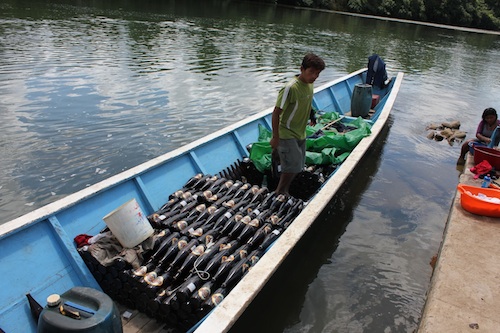
Merchants sell boatloads of beer to small indigenous communities newly flush with cash income  
A more insidious ‘leakage’ from the hydrocarbon economy is the social degradation that indigenous people themselves recognize as a threat to social cohesion and self-governance. Without communal planning and social controls, cash income is being wasted on days-long drinking binges.

Myriad company- and government-financed projects have failed due to lack of oversight: tap-water systems deliver contaminated water or no water at all[2]; flush toilets languish dry and abandoned; fish-culture ponds are washed away by rainy season floods; an expensive hospital boat lies capsized and useless.

Development investments in native communities have had disheartening results: Failed tap-water systems (left), filthy toilets (center), and a deteriorating schoolhouse (right).

About the only consistently successful infrastructure projects being built with the ~1 billion dollars in gas royalties received by the regional government over the past four years are… roads!

The lesson is that nature conservation in the face of petrochemical extraction in the Amazon must solve two challenges: companies must implement best practices, and we need stronger governance and improved health and education, with a focus on indigenous polities.[3]  This is the key.

The social degradation caused by misspent money and squandered projects not only blights lives, it also saps native populations’ capacity to defend 1.3 million ha of indigenous rainforest reserves and titled lands surrounding Camisea. This figure grows to 2 million ha if drilling proceeds in Madre de Dios, where Hunt Oil is currently prospecting.

It will be a tragedy if the hydrocarbon economy overwhelms indigenous cultures and destroys their well-documented ability to protect nature.[4] Without closer scrutiny of such insidious long-term impacts, the roadless utopia envisioned by Babbitt may prove to be a mirage.

"Roadless?":  The lion's share of gas royalties has gone to building... roads! 
---

Glenn H. Shepard Jr.
Department of Anthropology, Museu Paraense Emilio Goeldi
Belém do Pará, Brazil
Douglas W. Yu
School of Biological Sciences, University of East Anglia, Norwich, UK and
State Key Laboratory of Genetic Resources and Evolution, Kunming Institute of Zoology, Kunming, Yunnan, China


---This article is being published simultaneously with Spanish and Portuguese translation by O Eco Amazonia.

-- For updates on the Camisea situation, see: Camisea Hostage Crisis 


References:
[1]  J. Tollefson. Nov. 30, 2011. Fighting for the Forest: The Roadless Warrior. Nature 480(7375), 22-24.
[2]  For an example of successful water projects in nearby native communities of the Peruvian Amazon, see House of the Children.
[3]  D. Yu, T. Levi & G. Shepard. 2010. Conservation in low-governance environments. Biotropica 42(5): 569-571.
[4]  D. Nepstad et al. 2006. Inhibition of Amazon deforestation and fire by parks and indigenous lands. Conservation Biology 20(1): 65-73.