Showing posts with label hunting. Show all posts

February 15, 2017

Lessons from the Catwoman: Extinction and resilience of Amazonian fauna [exerpt from SAPIENS]

Francisco Evangelista, a Paumari Indian who grew up along the Piranha River within the Purus River basin in the Brazilian Amazon, tells a tale from his boyhood about a pelt hunter who went mad from his own excess. Speaking in backwoods Portuguese, Evangelista—who was raised by a rubber tapper whom he called patrão (“boss”)—recalls the day he and the patrão came upon this commercial hunter in distress.

“My boss found [the pelt hunter] on the river bank by a whole herd he had just killed, must have been 12 or 15 peccaries skinned and left to rot,” Evangelista recounts. “We had seen two more herds he had slaughtered a little farther up the river. He was crazy, scared, shaking, screaming about how the jaguars and peccaries were coming to get him because he had killed so many. We took him in our boat but he kept screaming and going crazier and crazier till finally he died, right in front of my eyes,” Evangelista says. “Our people know you can’t just go killing animals like that. It’s perverse. And the forest has its guardians.”

Hunting by local forest-dwelling people in the Amazon for subsistence and commercial purposes has long been considered by many conservationists to be a major threat to biodiversity conservation. In the 1990s, conservationists warned that unbridled hunting could result in “empty forests”—places where trees remain but large animals are eerily absent, hunted out by local people... But a recent study published in Science Advances analyzing historical data on commercial hunting throughout the 20th century tells a different story, showing that many terrestrial Amazonian species have proven more resilient than most experts expected... 


"The jaguar-fur suit worn by Catwoman in the 1966 film Batman: The Movie helped drive the trend..."
The international trade in Amazonian animal hides gradually increased after the collapse of the "Rubber Boom" in 1912, then experienced its first peak during World War II when the U.S. again sought wild rubber from the Brazilian Amazon after the capture of Malaysian rubber plantations by the Japanese. The influx of tens of thousands of rubber tappers meant more hunters in the forest taking advantage of a secondary income stream. The 1960s saw a second peak of Amazonian animal hide exports as exotic furs came into fashion in Europe and the United States. The jaguar-fur suit worn by Catwoman in the 1966 film Batman: The Movie helped drive the trend...

At least 23 million wild animals were killed for their pelts and skins in the Amazon during the heydey of commercial hunting in the 20th century.

But apart from the white-lipped peccary, terrestrial animal populations were surprisingly resilient in the face of all that hunting. In contrast, aquatic species like the giant river otter, black caiman, and manatee showed rapidly dwindling export numbers during the age of commercial hunting, despite steadily rising prices—proof that their population had collapsed under hunting pressure. The result was local extinction in aquatic and semiaquatic habitats—an “empty river” scenario… [but not] the “empty forest” scenario that some experts predicted.
---

Continue reading the full article in SAPIENS by Glenn Shepard and Emma Marris

Based on the paper "Empty forest or empty rivers? A century of commercial hunting in the Amazon," published in Science Advances 2(10). 


May 12, 2016

Water in Yomibato: Guest post by National Geographic writer Emma Marris

I traveled last November to Manu Park in the Peruvian Amazon with writer Emma Marris to guide her among the Matsigenka people for a story she published this week in National Geographic. In this post from the science blog The Last Word on Nothing (reproduced with permission), Emma describes her visit to the water purification system recently inaugurated in this remote village by the charity organization Rainforest Flow.

Text: Emma Marris
Photography: Glenn Shepard

Durable, hygienic drinking taps, sinks and bathrooms were installed near the Yomibato village school by Rainforest Flow.
Last November, I went to the Peruvian Amazon on assignment for National Geographic.  I focused on a group of indigenous people, the Matsigenka, living inside Manu National Park.

One of these people is Alejo Machipango
[1], a hunter, farmer, and member of the water committee for the village of Yomibato. Alejo is about 32, but I would have guessed his age at 22. He is married and has several kids. He is a jokester. He likes chewing coca, drinking manioc beer. He takes his arrows with him most places, just in case. I saw him shoot at some birds, but never hit one. And he always laughs when he misses.
 
Alejo with his arrows, just in case.

One day, Alejo takes me to see the spring where Yomibato gets its water. The water system in the village was installed by a charity called Rainforest Flow between 2012 and 2015.

A few generations ago, the Matsigenka used to be more dispersed on the landscape. Each family lived apart, and households moved often. The whole community would gather together once a month, on the full moon, and have a big party with manioc beer. But many families decided to move to Yomibato to be near the school and clinic. As the community grew to several hundred, the local river and streams became contaminated with bacteria and waterborne illness became a chronic problem.


The slow sand filtration treatment tanks, with water committee members.

The newly-installed water system itself is a very simple slow sand filtration setup. Water is piped from a spring away from the main village to a series of three portable geomembrane tanks[2] filled with sand and rocks. Microbes living on the sand gobble up bacteria, viruses, Giardia, Cryptosporidium, and parasites. The water is stored in a 30,000 liter bladder tank that is essentially a big tough geomembrane pillow, then is distributed throughout the village through pipes. The whole system is gravity fed, so there are no pumps, no electricity required, no moving parts. It is also light and easy to transport by canoe. It was designed by hydrological engineer Humphrey Blackburn. The water committee clean the filters every couple of months and repair pipe breaks, and that’s about it.

We cross the river by canoe, stop to look at the filters and reservoir, and then start climbing the foothills of the Andes towards the spring. When we get there, the spring itself looks like nothing. A wet spot in the ground. A pipe with holes in it is buried below the surface, I am told.

We sit down to rest in the hollows made by the huge buttressed roots of massive fig trees. Alejo says he knows a tree nearby that is fruiting, and he and his friend Alex disappear, then reappear with their T-shirts filled with brown seed pods, about five inches long. They are called azucar huayo in Spanish; koveni in Matsigenka
[3]. The water committee hack them open with machetes and begin eating the sweet brown fluffy stuff inside. It is almost too sweet.

Alex with azucar huayo.

I ask Alejo about laying the 16 kilometers of pipe the project required. “Everybody came to work,” he says. “The women came. We all suffered a lot.”
 

I ask him if it was worth it. Sometimes, I think, development projects are more about what rich people think a community ought to want, rather than what they actually do want. “If we had to do it again, we would.” Alejo says. “One of my children died of diarrhea, and I had it many times.”

He says this so matter of factly that I don’t say the kinds of things I would say if someone back home told me their child had died. I suppose that in a place where people have a dozen kids and where childhood mortality is relatively common, it is possible that the etiquette is a bit different. But in truth, I am stunned that this happy-go-lucky guy who looks like a teenager has lost a child. And as a mother, I feel that vaguely sick feeling you get whenever you hear about any child dying.


I wonder if he is on the water committee because his child died, or if he just thought he’d make a little money without having to leave the village—which is the way most people make money in Yomibato, if they need some for soap or cooking pots or gasoline. But I don’t know how to ask him any more about this dead child.

Nancy Santullo, founder and director of Rainforest Flow.

The American woman who runs Rainforest Flow, Nancy Santullo, sees clean water as a basic step on the road towards empowering indigenous communities that have historically been victimized by outsiders: paid less than non-natives for their work, denied benefits owed to them as citizens, abused by those sent to help them


She is on a spiritual quest to make the Matisgenka strong and confident. Alejo already seems strong and confident, but I don’t know. His smiles may cover a shell thicker than the koveni


We walk back along the pipe, and it is a hot day, like every day. When we get to the first house of the village, I stop and take a long cool drink from the tap.


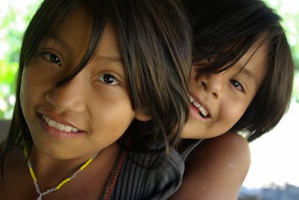
Access to clean, safe water has transformed health and sanitary conditions in the project communities, benefiting children especially.
---

Find out about Rainforest Flow's water projects in indigenous communities of the Peruvian Amazon at rainforestflow.org


Read more about the Matsigenka people and Manu Park in the June 2016 issue of National Geographic:

by Emma Marris
photography by Charlie Hamilton James

by Susan Goldberg
photography by Glenn Shepard


Notes: 
1.  As a young boy, Alejo appeared in the Discovery channel documentaries Spirits of the Rainforest (winner of two Emmys) and The Spirit Hunters, both filmed in Yomibato in 1992. Alejo's grandfather, Mariano Vicente, a storyteller, shaman, and "star" of the films, passed away in 2012. The Spirit Hunters , narrated by James Earl Jones, streams free online at Culture Unplugged.
2.  Slow sand filtration is a centuries-old technology used by many small towns as well as by the U.S. military on extended combat missions and the U.N. in disaster relief efforts. Read more at slowsandfilter.com/.
3.  Azucar huayo (or jatobá in Brazil) is a legume seed pod from the tree Hymenaea courbaril L.


June 20, 2012

Monkey-Frog at the Racetrack: Horse dope from the Amazon (Phyllomedusa frog venom)

More than thirty racehorses in Louisiana, Oklahoma, New Mexico and Texas have tested positive for an illegal performance-enhancing drug derived from South American frog venom.  As reported in today’s issue of the New York Times, racing regulators have long suspected that trainers were doping horses with dermorphin, a painkiller forty times more powerful than morphine that is found in skin secretions of the Waxy Monkey Leaf Frog, Phyllomedusa sauvagii, traded internationally as an exotic pet.  Dermorphin belongs to a novel class of compounds first identified in skin secretions of the related frog species Phyllomedusa bicolor, used as a stimulant by indigenous hunters of the Amazon.  Frog venom had so far evaded detection in racehorse drug screening until Denver-based Industrial Laboratories tweaked its tests.

Several Phyllomedusa species have toxic skin secretions

The Spiritain missionary Constantin Tastevin[i] was the first outsider to document the use of frog toxins known locally as kampo by Cashinahua (Kaxinawa) Indians of the upper Juruá River in Brazil.  The Cashinahua collect secretions from the Giant Waxy Monkey Frog (Phyllomedusa bicolor) and administer the substance directly into the bloodstream through small wounds burned with smoldering twigs on the skin.  The treatment produces short-lived bouts of nausea, sweating, vomiting, diarrhea and sometimes unconsciousness, but leaves the user with a lasting sense of strength, well-being and heightened sense perception.  The treatment is especially valued by indigenous hunters for improving their stamina, skill and luck at hunting.  "Hunting magic," as it is sometimes (and perhaps erroneously) called, proves to be an important category of traditional medicine in Amazonia. 

Since Tastevin’s early record, kampo use has been documented by anthropologists among other indigenous groups of the Brazil-Peru border region including the Amahuaca, Yaminahua, Matis, Matses (Mayoruna), Marubo, Katukina and Yawanawa.[ii]  Writer Peter Gorman’s 1993 article in Omni magazine[iii] on Matses "magic" in Peru -- echoing Gordon Wasson's famous 1957 story[iv] on the magic mushrooms of Mexico -- generated  widespread popular interest in the substance.  More recently, indigenous healers from the state of Acre have brought the “frog vaccine” to urban centers throughout Brazil as part of an expansion and popularization of indigenous shamanistic practices.[v]
 
Indigenous healers administer frog secretions directly into the bloodstream by means of small burns to the skin.

Berkeley anthropologist Katharine Milton first collected scientific samples of Phyllomedusa bicolor secretions among the Mayoruna of Brazil[vi] (the same group known as Matses on the Peruvian side of the border), and ensuing studies have revealed novel chemical compounds with a wide range of physiological and neurological activities.[vii]  Over 20 patents have since been registered on various compounds derived from Phyllomedusa venom, including dermorphin which is now synthesized and sold on-line.

Racehorse trainers have been known to use other exotic substances including cobra venom to improve horse performance and cheat at the tracks.  In addition to its analgesic effects, masking the pains of overexertion by horse or man, dermorphin appears to produce physiological excitement and euphoria.  Two of the horses testing positive for the substance in Louisiana had earned substantial purses.  As Louisiana's Racing Commission director Charles A. Gardiner III told the Times, “A lot of money’s got to be given back.” 

If only such ill-gotten winnings could be returned to the Matses…

---

References:

[i]  Tastevin, C. Le fleuve Muru. La Geographie 43: 14-35.
[ii] Carneiro, R. 1970. Hunting and Hunting Magic among the Amahuaca of the Peruvian Montaña. Ethnology 9(4): 331-341; 
     Erikson, P. 1996. La griffe des aïeux: Marquage du corps et démarquages ethniques chez les Matis d’Amazonie. Paris: CNRS/Peeters; 
     Lima, E.C. 2005. Kampu, kampo, kambô: O uso do sapo-verde entre os Katukina. Revista do IPHAN 32: 254-267; 
     Carneiro da Cunha, M. Des grenouilles et des hommes. Télérama hors série, Les Indiens du Brésil. March, 2005: 80-83.
[iii] Gorman, P. 1993. Making magic: A Westerner glimpses one of the secrets of a tribe of hunter-gatherers in the Amazon. Omni Magazine 15(9): 64. July, 1993.
[iv] Wasson, G. 1957. Seeking the magic mushroom. Life Magazine, May 13, 1957.
[v] Lima E.C. & B.C. Labate. 2012. Kambo: From the forests of Acre to the urban centers. Erowid.org. May 31, 2012.
[vi] Milton, K. 1994. No pain, no game. Natural History 9: 44-51.
[vii] Daly, J.W., J. Caceres, R.W. Moni, F. Gusovsky, M. Moos, K.B. Seamon, K. Milton, and C.W. Meyers. 1992. Frog secretions and hunting magic in the upper Amazon: Identification of a peptide that interacts with an adenose receptor. Proceedings of the National Academy of Sciences 89(22): 10960-10963.

February 16, 2012

Roadless (and Fishless) in Camisea: Insidious impacts of a gas pipeline in Peru

The road to Camisea, so the saying goes, may be paved with good intentions.

In a recent news feature in Nature magazine[1], Bruce Babbitt, former Secretary of the Interior of the United States and a prominent conservationist, lauds the conservation benefits of the ‘offshore-inland’ model for gas drilling in the sensitive Camisea region of Peru, where a consortium of companies led by PlusPetrol and Hunt Oil is currently pumping natural gas in a pipeline through the Amazon rain forest and across the Andes to refineries on the Pacific coast.


Local people blame gas spills and heavy river traffic for the disappearance of fish, their main source of protein.

The “roadless” model championed by Babbitt, using only air and river transportation to supply the gas wells, prevents much road-induced deforestation. It also aligns hydrocarbon extraction with conservation since forest cover bolsters pipeline security. And yet as César Gamboa of the Law, Environment and Natural Resources Center points out, avoiding direct deforestation is only the first small step.


Moreover, the Camisea pipeline has been beset by controversy, including six spills resulting from corroded pipes. Some have raised questions over the legality of contracts and the long-term sustainability of a project which is forever transforming not only Camisea and its indigenous peoples but also the entire energy matrix of Peru, all for what may prove to be only another decade’s worth of natural gas.

In our response to this Nature news feature, ecologist Douglas Yu and I call attention to the cascading impacts of the hydrocarbon economy on the region’s resources and indigenous peoples.  

During a recent visit to Camisea, every indigenous person we interviewed bemoaned the disappearance of fish, their main protein source. Although they blame boat traffic and gas leaks, we also suspect commercial overexploitation by booming regional markets.

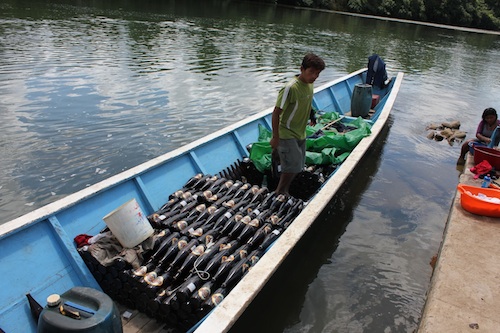
Merchants sell boatloads of beer to small indigenous communities newly flush with cash income  
A more insidious ‘leakage’ from the hydrocarbon economy is the social degradation that indigenous people themselves recognize as a threat to social cohesion and self-governance. Without communal planning and social controls, cash income is being wasted on days-long drinking binges.

Myriad company- and government-financed projects have failed due to lack of oversight: tap-water systems deliver contaminated water or no water at all[2]; flush toilets languish dry and abandoned; fish-culture ponds are washed away by rainy season floods; an expensive hospital boat lies capsized and useless.

Development investments in native communities have had disheartening results: Failed tap-water systems (left), filthy toilets (center), and a deteriorating schoolhouse (right).

About the only consistently successful infrastructure projects being built with the ~1 billion dollars in gas royalties received by the regional government over the past four years are… roads!

The lesson is that nature conservation in the face of petrochemical extraction in the Amazon must solve two challenges: companies must implement best practices, and we need stronger governance and improved health and education, with a focus on indigenous polities.[3]  This is the key.

The social degradation caused by misspent money and squandered projects not only blights lives, it also saps native populations’ capacity to defend 1.3 million ha of indigenous rainforest reserves and titled lands surrounding Camisea. This figure grows to 2 million ha if drilling proceeds in Madre de Dios, where Hunt Oil is currently prospecting.

It will be a tragedy if the hydrocarbon economy overwhelms indigenous cultures and destroys their well-documented ability to protect nature.[4] Without closer scrutiny of such insidious long-term impacts, the roadless utopia envisioned by Babbitt may prove to be a mirage.

"Roadless?":  The lion's share of gas royalties has gone to building... roads! 
---

Glenn H. Shepard Jr.
Department of Anthropology, Museu Paraense Emilio Goeldi
Belém do Pará, Brazil
Douglas W. Yu
School of Biological Sciences, University of East Anglia, Norwich, UK and
State Key Laboratory of Genetic Resources and Evolution, Kunming Institute of Zoology, Kunming, Yunnan, China


---This article is being published simultaneously with Spanish and Portuguese translation by O Eco Amazonia.

-- For updates on the Camisea situation, see: Camisea Hostage Crisis 


References:
[1]  J. Tollefson. Nov. 30, 2011. Fighting for the Forest: The Roadless Warrior. Nature 480(7375), 22-24.
[2]  For an example of successful water projects in nearby native communities of the Peruvian Amazon, see House of the Children.
[3]  D. Yu, T. Levi & G. Shepard. 2010. Conservation in low-governance environments. Biotropica 42(5): 569-571.
[4]  D. Nepstad et al. 2006. Inhibition of Amazon deforestation and fire by parks and indigenous lands. Conservation Biology 20(1): 65-73.

September 30, 2011

The Hunter in the Rye: Ergot, Sedges and Hunting Magic in the Peruvian Amazon

Abanti draws the string of a palm wood bow all the way to his ear, aiming the razor-sharp bamboo tip of an arrow straight up into the rain forest canopy. Eighty feet above, a large spider monkey eats Pouteria fruits, unaware of the human predator below. Then the black silhouette flinches, a fruit drops, and the monkey leaps to another branch.  “Wary. May have heard us,” he whispers to his brother-in-law as he releases the tension on the bow in a smooth snap.

"The muscles across his back stand out in relief as he draws and aims the taut bow."
He steps quietly, bending back a few spindly palms that block his view, never taking his eyes off the monkey high overhead. Once again he takes up his stance, but this time he removes a small cluster of plant bulbs from a net bag slung across his back. The bulbs are the roots of an alkaloid-rich sedge variety used for the specific purpose of hunting spider monkey. Snapping off a piece, he chews the bitter, aromatic quid, then rubs the masticated root onto his bow and arrow. Still watching the monkey, he spits a fine, turpentine-smelling spray upward. “Straight up, straight to the heart, no branches, fly straight and fast,” he mumbles to the bow, to the arrow, to the monkey, to himself.