March 31, 2012

Dark Shamans, Goth and Kittens: Remembering Neil Whitehead


Neil Lancelot Whitehead
1956 - 2012

Amazonian anthropology has lost another innovative voice, cherished friend and "astronaut of the human soul" this month. Neil L. Whitehead was best known for his explorations on the "dark side" of shamanism. Eschewing romantic depictions of benevolent shaman-healers, he drew connections between indigenous sorcery and sexualized tribal and political violence in the Guianas from colonial through modern times.

With his flowing blonde hair, dramatic British accent and electrifying stage presence, Neil looked like he beIonged in a heavy metal band. Which he did. As part of a "performative ethnographic work" in collaboration with Jeff Fields, Neil took on the persona of Detonator, lead singer of Blood Jewel. The band participated in Goth festivals in Europe and recorded bone-crunching industrial music that plumbs similarly dark themes of violence and terror, fetishized sexuality and the post-human condition.

And yet scattered among heavy postings on his Facebook page one also finds warm family correspondence and cute kitten photos. All who knew and admired Neil mourn his passing and honor his legacy.

  
Left: Onstage as "Detonator" with Blood Jewel;
Right: A recent co-edited volume on post-humanity.


More about Neil's life and work:

March 19, 2012

"Astronaut of the Human Soul": In Memoriam - Steven Rubenstein


Anthropology is a special vocation; you and I did not select the ordinary job or anything close to it.  We are astronauts of the human soul, half scientist  and half explorer, part poet and part trickster.

-- Steven Rubenstein (1962 - 2012)

This month, the anthropological community lost a provocative and productive scholar, a passionate advocate for indigenous rights, a generous colleague and a gentle friend.  He will be sorely missed.  

-----

For more about Steven's life and work: 

"Astronauts" quote by Steven courtesy of Juan Pablo Sarmiento Barletti

---

Amazonian anthropology lost another "astronaut of the human soul" this month with the death of Neil Lancelot Whitehead:
see "Dark Shamans, Goth and Kittens"


February 16, 2012

Roadless (and Fishless) in Camisea: Insidious impacts of a gas pipeline in Peru

The road to Camisea, so the saying goes, may be paved with good intentions.

In a recent news feature in Nature magazine[1], Bruce Babbitt, former Secretary of the Interior of the United States and a prominent conservationist, lauds the conservation benefits of the ‘offshore-inland’ model for gas drilling in the sensitive Camisea region of Peru, where a consortium of companies led by PlusPetrol and Hunt Oil is currently pumping natural gas in a pipeline through the Amazon rain forest and across the Andes to refineries on the Pacific coast.


Local people blame gas spills and heavy river traffic for the disappearance of fish, their main source of protein.

The “roadless” model championed by Babbitt, using only air and river transportation to supply the gas wells, prevents much road-induced deforestation. It also aligns hydrocarbon extraction with conservation since forest cover bolsters pipeline security. And yet as César Gamboa of the Law, Environment and Natural Resources Center points out, avoiding direct deforestation is only the first small step.


Moreover, the Camisea pipeline has been beset by controversy, including six spills resulting from corroded pipes. Some have raised questions over the legality of contracts and the long-term sustainability of a project which is forever transforming not only Camisea and its indigenous peoples but also the entire energy matrix of Peru, all for what may prove to be only another decade’s worth of natural gas.

In our response to this Nature news feature, ecologist Douglas Yu and I call attention to the cascading impacts of the hydrocarbon economy on the region’s resources and indigenous peoples.  

During a recent visit to Camisea, every indigenous person we interviewed bemoaned the disappearance of fish, their main protein source. Although they blame boat traffic and gas leaks, we also suspect commercial overexploitation by booming regional markets.

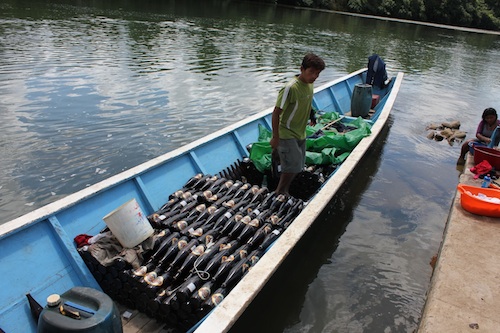
Merchants sell boatloads of beer to small indigenous communities newly flush with cash income  
A more insidious ‘leakage’ from the hydrocarbon economy is the social degradation that indigenous people themselves recognize as a threat to social cohesion and self-governance. Without communal planning and social controls, cash income is being wasted on days-long drinking binges.

Myriad company- and government-financed projects have failed due to lack of oversight: tap-water systems deliver contaminated water or no water at all[2]; flush toilets languish dry and abandoned; fish-culture ponds are washed away by rainy season floods; an expensive hospital boat lies capsized and useless.

Development investments in native communities have had disheartening results: Failed tap-water systems (left), filthy toilets (center), and a deteriorating schoolhouse (right).

About the only consistently successful infrastructure projects being built with the ~1 billion dollars in gas royalties received by the regional government over the past four years are… roads!

The lesson is that nature conservation in the face of petrochemical extraction in the Amazon must solve two challenges: companies must implement best practices, and we need stronger governance and improved health and education, with a focus on indigenous polities.[3]  This is the key.

The social degradation caused by misspent money and squandered projects not only blights lives, it also saps native populations’ capacity to defend 1.3 million ha of indigenous rainforest reserves and titled lands surrounding Camisea. This figure grows to 2 million ha if drilling proceeds in Madre de Dios, where Hunt Oil is currently prospecting.

It will be a tragedy if the hydrocarbon economy overwhelms indigenous cultures and destroys their well-documented ability to protect nature.[4] Without closer scrutiny of such insidious long-term impacts, the roadless utopia envisioned by Babbitt may prove to be a mirage.

"Roadless?":  The lion's share of gas royalties has gone to building... roads! 
---

Glenn H. Shepard Jr.
Department of Anthropology, Museu Paraense Emilio Goeldi
Belém do Pará, Brazil
Douglas W. Yu
School of Biological Sciences, University of East Anglia, Norwich, UK and
State Key Laboratory of Genetic Resources and Evolution, Kunming Institute of Zoology, Kunming, Yunnan, China


---This article is being published simultaneously with Spanish and Portuguese translation by O Eco Amazonia.

-- For updates on the Camisea situation, see: Camisea Hostage Crisis 


References:
[1]  J. Tollefson. Nov. 30, 2011. Fighting for the Forest: The Roadless Warrior. Nature 480(7375), 22-24.
[2]  For an example of successful water projects in nearby native communities of the Peruvian Amazon, see House of the Children.
[3]  D. Yu, T. Levi & G. Shepard. 2010. Conservation in low-governance environments. Biotropica 42(5): 569-571.
[4]  D. Nepstad et al. 2006. Inhibition of Amazon deforestation and fire by parks and indigenous lands. Conservation Biology 20(1): 65-73.

January 26, 2012

Close Encounters of the Mashco Kind: Fatal attack by an isolated indigenous group in Peru


The look on Casiano’s face was beginning to worry me.  He had been helping me and Harvard ecologist Douglas Yu hack trails, scale trees and collect specimens in a thorny thicket of bamboo two miles across the river from the native community of Tayakome within Manu National Park in the Peruvian Amazon. Strange sounds had piqued Casiano’s ears and distracted his attention from the tedium of science. Agosto, another of our Matsigenka guides, left Doug and came to Casiano’s side.


“Did you hear that?!” Casiano pointed, as if aiming an arrow, into the shaded depths of the forest. I heard nothing but the background symphony of cicadas and birds.
 
“Tortoises?” asked Agosto hopefully.

“There!” pointed Casiano further to his left. “Bamboo breaking.”

“Maybe a jaguar…” said Agosto, not sounding convinced.

There was an urgent edge in their voices and expressions, something I had never before observed besetting the Matisgenka’s tacit confidence within the forest and its many predicaments: something approaching panic. Doug called out, “Could you tell Agosto to bring back my tape measure?”

Just then, not more than twenty yards ahead of us, the forest rang with an eerie, hollow whistle—a miracle of acoustics produced by cupping one hand over the chin and blowing across the thumbnail—that the Matsigenka use as a hail. Only there were no Matsigenka in front of us.

Casiano went pale and whispered, “Mashco.”

This Mashco-Piro group was photographed from across the river by Diego Cortijo just a few days before they presumably killed Cortijo's native guide and my old friend, Shaco Flores, in November. (photo source: Survival International)

For an update on the evolving situation of the Mashco-Piro, see the more recent posting "Mashco-Piros on the Verge: Missionaries, human safaris, head-ball and a tale of two contacts"

December 30, 2011

Bittersweet: An excerpt from the forthcoming book "Sorcery of the Senses"

Every time I eat watermelon I remember that day.  It was the dry season, when the rust-red floodwaters of Quebrada Fierro or “Iron Creek” subside to a lazy trickle, exposing wide, meandering beaches near its mouth on the upper Manu River in southern Peru.  I was with a group of Matsigenka men and boys, we had spent the past few hours under a feverish noon sun portaging boat, motor and gear to circumvent a stubborn Dipteryx trunk, impervious as tempered glass, that blocked dry season passage along the creek.  


It was the summer of 1995 and I was taking Hiram, a dear Matsigenka friend who called me “brother,” to meet up with a film crew camped out at the research station of Cocha Cashu down river.  I was helping Hiram’s community negotiate for an upcoming shoot.  Cheronto, who came from a rival community nearer the station, was the best boat pilot in the region.  He was taking us down the river to close the negotiations.

Sweaty, thirsty, and famished, we trudged across the searing sand when someone up ahead cried out, “Watermelons!”  Senegui, an affable widower who lived nearby, seeded the beaches with watermelons every summer, and this year was a bumper crop.

“There are more over here,” called someone else.  “And are they ripe!”


Click HERE to read the full text published in "Dispatches" for December 14 on The Common.


November 22, 2011

The Ant, the Shaman and the Scientist: Shamanic lore spurs scientific discovery in the Amazon

When he pointed to the tree trunk and said the scars were from fires set by invisible forest spirits, I had no idea this supernatural observation would lead to a new discovery for natural science.  Mariano, the eldest shaman (who has since passed away) of the Matsigenka village of Yomibato in Manu National Park, Peru, had first showed me the curious clearings in the forest that form around clumps of Cordia nodosa, a bristly tropical shrub related to borage (Borago officinalis).  Both the Matsigenka people and tropical ecologists recognize the special relationship that exists between Cordia and ants of the genus Myrmelachista: the Matsigenka word for the plant is matiagiroki, which means “ant shrub.”

Maximo Vicente, Mariano's grandson, standing by a 
swollen, scarred trunk near a Cordia patch.
For scientists, the clearings in the forest understory around patches of Cordia are caused by a mutualistic relationship with the ants.  Cordia plants provide the ant colony with hollow branch nodes for nesting and bristly corridors along twigs and leaves for protection, while the ants use their strong mandibles and acidic secretions to clear away competing vegetation.  Local Quechua-speaking colonists refer to the clearings as “Devil’s gardens” (supay chacra).  For the Matsigenka, these clearings are the work of spirits known as Sangariite, which means ‘Pure’ or ‘Invisible Ones’.  Matsigenka shamans like Mariano come to these spirit clearings and consume powerful narcotics and hallucinogens such as tobacco paste, ayahuasca (Banisteriopsis), or the Datura-like toé (Brugmansia).[1]

October 13, 2011

Wizard of the Upper Silicon: The Steve Jobs legacy in Amazonia

Moises da Silva, a Baniwa film maker, reviews the day's footage on his MacBook;
Aiary River, Upper Rio Negro, October 2010.

Whatever your opinion about his business model, labor policies, or global media empire, one thing is for sure:  Steve Jobs forever changed the way we all use digital technology.  From Silicon valley to the upper Amazon, words like "mouse," "click," "drag," "notebook," and "iTunes" have become household -- even thatched hut -- vocabulary in all conceivable languages. Not merely portable but downright personable computers have transformed and revolutionized the way we work, play, communicate with one another and project our individual and collective selves to the world. 


Far from being overrun by modern technology, indigenous groups of the Amazon like the Baniwa, Kayapó, and many others have found ways to use digital tools to engage with the international public and reinforce their own traditions and values. The Baniwa video documentation project pictured here has received support from Brazil's Ministry of Culture. Baniwa high school students at the remote Pamaali community use a satellite internet link powered by solar panels to surf the web, exchange email with family and friends in distant cities like São Gabriel and Manaus, and post a regular web log of their own.


Moises prepares to film as a ceremonial
longhouse is being constructed
Baniwa children warm up at a bonfire by the
longhouse after the ritual is done
A Baniwa shaman supervises
the ceremony and filming


We cannot attribute the entire digital revolution to one man, but Jobs made a singular contribution by taking the "tech" out of "high-tech," developing elegantly intuitive, deceptively effortless, and widely imitated designs for interfacing between devices of all types and humans of all ages, professions and cultures. This posting is dedicated to his legacy.


-- The digital culture projects mentioned here are featured at the Goeldi Museum's  current "Amazonidas" exhibit. The Goeldi Linguistics department has a large documentation program for indigenous languages.

September 30, 2011

The Hunter in the Rye: Ergot, Sedges and Hunting Magic in the Peruvian Amazon

Abanti draws the string of a palm wood bow all the way to his ear, aiming the razor-sharp bamboo tip of an arrow straight up into the rain forest canopy. Eighty feet above, a large spider monkey eats Pouteria fruits, unaware of the human predator below. Then the black silhouette flinches, a fruit drops, and the monkey leaps to another branch.  “Wary. May have heard us,” he whispers to his brother-in-law as he releases the tension on the bow in a smooth snap.

"The muscles across his back stand out in relief as he draws and aims the taut bow."
He steps quietly, bending back a few spindly palms that block his view, never taking his eyes off the monkey high overhead. Once again he takes up his stance, but this time he removes a small cluster of plant bulbs from a net bag slung across his back. The bulbs are the roots of an alkaloid-rich sedge variety used for the specific purpose of hunting spider monkey. Snapping off a piece, he chews the bitter, aromatic quid, then rubs the masticated root onto his bow and arrow. Still watching the monkey, he spits a fine, turpentine-smelling spray upward. “Straight up, straight to the heart, no branches, fly straight and fast,” he mumbles to the bow, to the arrow, to the monkey, to himself.

August 20, 2011

The Challenge of Life Hill: Magical landmark in the Brazilian Amazon metes out destiny like the Fates

For two hours we watched storm clouds gather as our speedboat cut through coffee-colored waves on the Içana River. We beached at the base of a sandy cliff called Paitsidzapani in the Baniwa language, named for a kind of edible frog. Brazilian Portuguese has no word for such herpetological minutiae, so the Baniwa also call the place Serra do Desafio da Vida, or “Challenge of Life Hill.” Baniwa Indians stop here to partake of its dual enchantments: some stay at the base to gather coal shards endowed with a miraculous capacity to promulgate the eponymous (and by all accounts delectable) frogs. The brave, however, look towards the top, fix their eyes on dry twigs lining the precipice, and climb the steep embankment.

The sandy cliffs of Life Hill reflected in the river
In this landscape of dwarf forests, swamps and sand dunes along the Brazil-Colombia border, the hill metes out destiny like the Fates: those who top out with a steady stride and plant a tree branch along the ledge will be blessed by a long and healthy life; those who break stride and pause to rest are doomed to die young.   
Life Hill is less arbitrary than unbending Atropos, since cardiovascular capacity certainly correlates with longevity. Yet this is no light-hearted athletic feat: Abel, my Baniwa companion, said that his sister collapsed halfway up and was dead within a few years.
As most of our party ascended, I considered from below. Although not foolhardy, I enjoy a reasonable physical challenge. But as an ethnobotanist—half scientist, half mystic—I maintain a cautious respect for taboo and superstition, which have an uncanny penchant for truth. Yet the hill couldn’t have been higher than fifty yards.  It was steep, but I’m in pretty good shape. My only worry was a nagging knee. 
I began at a brisk jog, almost a sprint. I covered the first fifteen yards easily. Abel shouted from the top, “Don’t wear yourself out!” I reverted to a lunging stride, already breathing sharply and regretting the initial exertion as the path got steeper.
The hill, like life, is deceptive. The sand looked soft and inviting, but as I climbed it became deep and white and treacherous as a snowdrift. As the slope increased, the ground seemed to suck energy through the bottom of my feet. There is a mechanical explanation: the yielding sand absorbs impact and impulse, stealing the drive out of each forward lunge. But for the superstitious soul, there is a spiking sense of desperation, “What if I don’t make it?!”


Ancient petroglyphs along the Içana River
Halfway up, and I was in trouble. Fatigue set in just as the slope steepened wickedly. My heart pounded and my lungs ached as urgently as my burning legs. My stride became erratic as I slogged through collapsing powder, pausing longer after each footfall. About three-quarters up, my bad knee panged and I lurched to the left, almost losing my balance in calf deep-sand. I thought it was over. But I righted myself with an outstretched hand and leaned forward as far as I could, agonizing through the final steps. Human will, for all its tenacity, eventually meets the wall of physical limitation:  ten more feet and I would have collapsed. But I had reached the top. 
With a crazed heart slamming in my ears, I bent forward to breathe, but Abel urged, “Don’t stop!  Run and plant your branch!”
It was the hardest part of the trial. With leaden feet, burning thighs, racing heart, and panicky breath, I shambled toward the scrub forest and broke off a sturdy living branch with shriveled, olive-like fruits. I limped back to the cliff and planted my branch alongside a few fresh twigs and many withered ones. I looked out over the spectacular vista that swam and pulsed before my eyes: a tapestry of forest stretching to the horizon, broken only by a band of white sand and the reddish-black ribbon of the river. Tall rain clouds were moving toward us. A ferocious bolt of lightning cracked and its thunder roared over the forest like a breaking tidal wave. 
“Whenever someone climbs, the shamans of the Jaguar Clan throw thunderbolts,” said Abel. “This is where their souls enter the mountain.”
We raced down the hill, falling carefree through the crazed channels we had dredged up, and which the wind and the rain would soon smooth over. To finalize the rite and seal its augury for our party, we all dove, head first and fully clothed, into the icy black pool at the foot of the precipice.

White sand and black water under a cloudy sky
-- This piece was first published by The Common on February 23, 2011

June 29, 2011

Might at the Museum: Indigenous groups revisit their heritage at the Goeldi Museum

Visitors idling on a hot Saturday afternoon through the shady grounds of the Goeldi Museum’s Zoobotanical Park in downtown Belém, Brazil, gawked and snapped photos of the unanticipated spectacle:  more than thirty Kayapó Indians in full ceremonial regalia had just entered through the front gate. I walked alongside Mro-ô, leader of the Kayapó village of Turedjam in southern Pará state. I had invited Mro-ô and his people to participate in the inauguration of a new exhibit[1] celebrating the Goeldi Museum’s 145 years at the forefront of research into the cultural diversity and human history of the Amazon basin. The exhibit, running from June through September, includes ethnographic artifacts collected among the Kayapó by different researchers from the early 1900s through the present.

A Kayapó family poses in the Goeldi's Zoobotanical Park beside a life-size photograph of a Kayapó who visited the museum in 1903

Ethnographic collections have typically been regarded as “graveyards of objects”[2] belonging to cultures that are already extinct or in a process of extinction. However in recent decades, indigenous peoples of the Amazon have conquered new forms of political engagement and developed unique interfaces with modernity. Such changes demand a new approach to museum science and ethnographic collections. The Goeldi Museum has pioneered a kind of museum science that puts indigenous peoples into dialog with their own cultural heritage, an approach we call “ethnomuseology.” According to Lucia van Velthem, curator of the Goeldi collections for many years, “ethnographic objects possess a relationship of continuity with their cultures of origin.”[3]

Kayapó villagers from Turedjam visit the new exhibit at the Goeldi Museum

The visit of the Kayapó to the museum in late June represents the culmination of an ongoing research project that is built around this philosophy.