June 20, 2012

Monkey-Frog at the Racetrack: Horse dope from the Amazon (Phyllomedusa frog venom)

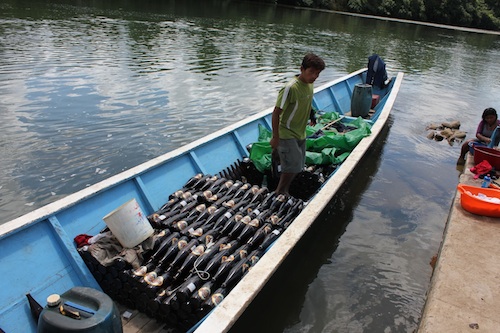
More than thirty racehorses in Louisiana, Oklahoma, New Mexico and Texas have tested positive for an illegal performance-enhancing drug derived from South American frog venom.  As reported in today’s issue of the New York Times, racing regulators have long suspected that trainers were doping horses with dermorphin, a painkiller forty times more powerful than morphine that is found in skin secretions of the Waxy Monkey Leaf Frog, Phyllomedusa sauvagii, traded internationally as an exotic pet.  Dermorphin belongs to a novel class of compounds first identified in skin secretions of the related frog species Phyllomedusa bicolor, used as a stimulant by indigenous hunters of the Amazon.  Frog venom had so far evaded detection in racehorse drug screening until Denver-based Industrial Laboratories tweaked its tests.

Several Phyllomedusa species have toxic skin secretions

The Spiritain missionary Constantin Tastevin[i] was the first outsider to document the use of frog toxins known locally as kampo by Cashinahua (Kaxinawa) Indians of the upper Juruá River in Brazil.  The Cashinahua collect secretions from the Giant Waxy Monkey Frog (Phyllomedusa bicolor) and administer the substance directly into the bloodstream through small wounds burned with smoldering twigs on the skin.  The treatment produces short-lived bouts of nausea, sweating, vomiting, diarrhea and sometimes unconsciousness, but leaves the user with a lasting sense of strength, well-being and heightened sense perception.  The treatment is especially valued by indigenous hunters for improving their stamina, skill and luck at hunting.  "Hunting magic," as it is sometimes (and perhaps erroneously) called, proves to be an important category of traditional medicine in Amazonia. 

Since Tastevin’s early record, kampo use has been documented by anthropologists among other indigenous groups of the Brazil-Peru border region including the Amahuaca, Yaminahua, Matis, Matses (Mayoruna), Marubo, Katukina and Yawanawa.[ii]  Writer Peter Gorman’s 1993 article in Omni magazine[iii] on Matses "magic" in Peru -- echoing Gordon Wasson's famous 1957 story[iv] on the magic mushrooms of Mexico -- generated  widespread popular interest in the substance.  More recently, indigenous healers from the state of Acre have brought the “frog vaccine” to urban centers throughout Brazil as part of an expansion and popularization of indigenous shamanistic practices.[v]
 
Indigenous healers administer frog secretions directly into the bloodstream by means of small burns to the skin.

Berkeley anthropologist Katharine Milton first collected scientific samples of Phyllomedusa bicolor secretions among the Mayoruna of Brazil[vi] (the same group known as Matses on the Peruvian side of the border), and ensuing studies have revealed novel chemical compounds with a wide range of physiological and neurological activities.[vii]  Over 20 patents have since been registered on various compounds derived from Phyllomedusa venom, including dermorphin which is now synthesized and sold on-line.

Racehorse trainers have been known to use other exotic substances including cobra venom to improve horse performance and cheat at the tracks.  In addition to its analgesic effects, masking the pains of overexertion by horse or man, dermorphin appears to produce physiological excitement and euphoria.  Two of the horses testing positive for the substance in Louisiana had earned substantial purses.  As Louisiana's Racing Commission director Charles A. Gardiner III told the Times, “A lot of money’s got to be given back.” 

If only such ill-gotten winnings could be returned to the Matses…

---

References:

[i]  Tastevin, C. Le fleuve Muru. La Geographie 43: 14-35.
[ii] Carneiro, R. 1970. Hunting and Hunting Magic among the Amahuaca of the Peruvian Montaña. Ethnology 9(4): 331-341; 
     Erikson, P. 1996. La griffe des aïeux: Marquage du corps et démarquages ethniques chez les Matis d’Amazonie. Paris: CNRS/Peeters; 
     Lima, E.C. 2005. Kampu, kampo, kambô: O uso do sapo-verde entre os Katukina. Revista do IPHAN 32: 254-267; 
     Carneiro da Cunha, M. Des grenouilles et des hommes. Télérama hors série, Les Indiens du Brésil. March, 2005: 80-83.
[iii] Gorman, P. 1993. Making magic: A Westerner glimpses one of the secrets of a tribe of hunter-gatherers in the Amazon. Omni Magazine 15(9): 64. July, 1993.
[iv] Wasson, G. 1957. Seeking the magic mushroom. Life Magazine, May 13, 1957.
[v] Lima E.C. & B.C. Labate. 2012. Kambo: From the forests of Acre to the urban centers. Erowid.org. May 31, 2012.
[vi] Milton, K. 1994. No pain, no game. Natural History 9: 44-51.
[vii] Daly, J.W., J. Caceres, R.W. Moni, F. Gusovsky, M. Moos, K.B. Seamon, K. Milton, and C.W. Meyers. 1992. Frog secretions and hunting magic in the upper Amazon: Identification of a peptide that interacts with an adenose receptor. Proceedings of the National Academy of Sciences 89(22): 10960-10963.

May 16, 2012

Camisea Hostage Crisis: Matsigenka natives locate Peruvian commandos ambushed by Sendero Luminoso

It took a pair of Matsigenka natives, armed only with machetes and jungle savvy, to retrieve the fallen commando after the Peruvian military, using helicopter gunships and hundreds of troops, failed after searching for nearly three weeks.

On April 9, Sendero Luminoso guerrillas stormed Kepashiato town square in the Peruvian rainforest north of Cusco and took hostage 36 workers on the Camisea gas pipeline, demanding $10 million in ransom.  Peruvian police and military commandos were helicoptered in three days later but the rescue mission ended in disaster:  one soldier, Landert Tamani, was killed, while two others, badly wounded, were abandoned in the retreat.  For the next seventeen days, the Peruvian press followed the dramatic search for the missing men, José Astuquilca and Cesar Vilca.

(Photo source: LaMula.pe)

The hostages were freed suddenly on April 14, and although the Peruvian government and the Camisea pipeline consortium have denied any such negotiations, it is widely presumed that a substantial ransom was paid.  Military operations continued as some 1500 police and soldiers combed the jungle to hunt out Sendero fighters and rescue the missing men.  Matsigenka villagers abandoned their homes and fled from the heavy bombardment.  But by the end of April, six more Peruvian troops were dead and the two wounded men were still missing.

Then on April 29, two native Matsigenka women from the community of Inkaari found José Astuquilca alive and helped him get to the small town of Kiteni on the lower Urubamba River.  Dionisio Vilca went to the remote region by himself and hired two Matsigenka guides to help search for his own missing son.  On May 2, they located Cesar Vilca's body less than 300 yards from where the ambush had first taken place.   

Cesar Vilca
(Photo source: LaMula.pe)

The Peruvian press has lambasted the military and police for abandoning the wounded soldiers, and for the travesty of the botched rescue mission.  With a growing public outcry, the Ministers of Defense and the Interior recently resigned.

Yet the episode also highlights the bravery and dire predicament of the anonymous heroes of the story, the Matsigenka, an indigenous people caught up in the rapid and sometimes chaotic transformations ushered in by the Camisea gas pipeline.

Camisea pipeline during construction
(Photo source: Panoramio)
The Camisea gas project has brought in over 4 billion dollars in foreign investment to Peru's booming economy, and the regional government of Cusco has received roughly $1 billion in direct royalty payments.  The municipality of Echarate, where these events unfolded, is now among the richest in Peru, awash in royalty payments from the Camisea gas fields.

Camisea pumping station at Malvinas
(Photo source: Panoramio)

And yet the Matsigenka and other native communities within Echarate have seen minimal long-term benefits:  large amounts of development money have been wasted on failed projects, fish and game populations have dwindled, social problems like alcoholism and prostitution have multiplied while health care remains precarious.  Yet another gas spill (the 7th in the 8-year history of the pipeline) was reported in March, contaminating streams near the Matsigenka community of Camaná.  A wave of illnesses and several recent deaths in Camaná have been blamed on the spill, though these claims are still being investigated.

The recent hostage-taking incident and dramatic resurgence of Sendero Luminoso reveal further dark consequences of gas development in this region.  One can only hope that the Peruvian government will emerge from this tragedy with a renewed covenant not only with its armed forces, but also with its unsung native heroes.

-----

Media sources:

April 11, 2012

Miss Kayapó: Filming through Mebengokre Cameras

In a make-shift editing room in Belém, Brazil, seven aspiring Kayapó filmmakers hunch over laptops viewing footage shot during the prior year. These young men, representing three Mebengokre-Kayapó villages, are part of a Goeldi Museum project funded by Brazil’s National Research Council (CNPq) that is providing indigenous communities with equipment and training in digital film production. After three days of editing, the novice cinematographers are ready to screen their first films.

Some, such as the Woman’s Festival
and Belo Monte Dam Protest are examples of what Terence Turner calls “cultural performance,” a staple element in indigenous-made films.[i] Others focus on less usual topics: a professional soccer game in Rio de Janeiro and a local health worker’s explicit presentation on STDs.

The most intriguing work, however, is Miss Kayapó
, a forty-minute documentary about a beauty contest held yearly in a Brazilian town near Kayapó territory.

A video still from "Miss Kayapó"

With a backdrop of São João carnival fairgrounds, neon-lit Ferris wheels, and a country band warming up, adolescent Kayapó girls saunter one-by-one around a makeshift runway painted in chalk on the dusty ground. As during traditional Kayapó dance festivals, the girls wear long bead necklaces, wide bracelets, and brightly colored bikini underwear. Their bare torsos are decorated with elaborate geometric patterns in black Genipa

Far from traditional, however, is the girls' deliberately swaying gait, punctuated by a dramatic pause at each corner of the chalk runway, hands on cocked hips, with pouting lips and a sultry tilt of the head. This erotic body language, which they have learned from watching fashion models on Brazilian TV, is a far cry from the collective feminine stomping of traditional Kayapó dance performance.

Before the beauty contest, villagers perform a traditional dance on the fairground
The clash of cultural traditions captured in Miss Kayapó raises a troublesome question: is the film self-degrading, subverting native self-understandings and aping Western paradigms in the worst possible way?[ii] 

The Menire Biok festival celebrates traditional notions of feminine power and beauty
Not if you ask Tatajere and Pymare, the film’s creators:  “We are showing Kayapó beauty to all Brazilians.”

March 31, 2012

Dark Shamans, Goth and Kittens: Remembering Neil Whitehead


Neil Lancelot Whitehead
1956 - 2012

Amazonian anthropology has lost another innovative voice, cherished friend and "astronaut of the human soul" this month. Neil L. Whitehead was best known for his explorations on the "dark side" of shamanism. Eschewing romantic depictions of benevolent shaman-healers, he drew connections between indigenous sorcery and sexualized tribal and political violence in the Guianas from colonial through modern times.

With his flowing blonde hair, dramatic British accent and electrifying stage presence, Neil looked like he beIonged in a heavy metal band. Which he did. As part of a "performative ethnographic work" in collaboration with Jeff Fields, Neil took on the persona of Detonator, lead singer of Blood Jewel. The band participated in Goth festivals in Europe and recorded bone-crunching industrial music that plumbs similarly dark themes of violence and terror, fetishized sexuality and the post-human condition.

And yet scattered among heavy postings on his Facebook page one also finds warm family correspondence and cute kitten photos. All who knew and admired Neil mourn his passing and honor his legacy.

  
Left: Onstage as "Detonator" with Blood Jewel;
Right: A recent co-edited volume on post-humanity.


More about Neil's life and work:

March 19, 2012

"Astronaut of the Human Soul": In Memoriam - Steven Rubenstein


Anthropology is a special vocation; you and I did not select the ordinary job or anything close to it.  We are astronauts of the human soul, half scientist  and half explorer, part poet and part trickster.

-- Steven Rubenstein (1962 - 2012)

This month, the anthropological community lost a provocative and productive scholar, a passionate advocate for indigenous rights, a generous colleague and a gentle friend.  He will be sorely missed.  

-----

For more about Steven's life and work: 

"Astronauts" quote by Steven courtesy of Juan Pablo Sarmiento Barletti

---

Amazonian anthropology lost another "astronaut of the human soul" this month with the death of Neil Lancelot Whitehead:
see "Dark Shamans, Goth and Kittens"


February 16, 2012

Roadless (and Fishless) in Camisea: Insidious impacts of a gas pipeline in Peru

The road to Camisea, so the saying goes, may be paved with good intentions.

In a recent news feature in Nature magazine[1], Bruce Babbitt, former Secretary of the Interior of the United States and a prominent conservationist, lauds the conservation benefits of the ‘offshore-inland’ model for gas drilling in the sensitive Camisea region of Peru, where a consortium of companies led by PlusPetrol and Hunt Oil is currently pumping natural gas in a pipeline through the Amazon rain forest and across the Andes to refineries on the Pacific coast.


Local people blame gas spills and heavy river traffic for the disappearance of fish, their main source of protein.

The “roadless” model championed by Babbitt, using only air and river transportation to supply the gas wells, prevents much road-induced deforestation. It also aligns hydrocarbon extraction with conservation since forest cover bolsters pipeline security. And yet as César Gamboa of the Law, Environment and Natural Resources Center points out, avoiding direct deforestation is only the first small step.


Moreover, the Camisea pipeline has been beset by controversy, including six spills resulting from corroded pipes. Some have raised questions over the legality of contracts and the long-term sustainability of a project which is forever transforming not only Camisea and its indigenous peoples but also the entire energy matrix of Peru, all for what may prove to be only another decade’s worth of natural gas.

In our response to this Nature news feature, ecologist Douglas Yu and I call attention to the cascading impacts of the hydrocarbon economy on the region’s resources and indigenous peoples.  

During a recent visit to Camisea, every indigenous person we interviewed bemoaned the disappearance of fish, their main protein source. Although they blame boat traffic and gas leaks, we also suspect commercial overexploitation by booming regional markets.

Merchants sell boatloads of beer to small indigenous communities newly flush with cash income  
A more insidious ‘leakage’ from the hydrocarbon economy is the social degradation that indigenous people themselves recognize as a threat to social cohesion and self-governance. Without communal planning and social controls, cash income is being wasted on days-long drinking binges.

Myriad company- and government-financed projects have failed due to lack of oversight: tap-water systems deliver contaminated water or no water at all[2]; flush toilets languish dry and abandoned; fish-culture ponds are washed away by rainy season floods; an expensive hospital boat lies capsized and useless.

Development investments in native communities have had disheartening results: Failed tap-water systems (left), filthy toilets (center), and a deteriorating schoolhouse (right).

About the only consistently successful infrastructure projects being built with the ~1 billion dollars in gas royalties received by the regional government over the past four years are… roads!

The lesson is that nature conservation in the face of petrochemical extraction in the Amazon must solve two challenges: companies must implement best practices, and we need stronger governance and improved health and education, with a focus on indigenous polities.[3]  This is the key.

The social degradation caused by misspent money and squandered projects not only blights lives, it also saps native populations’ capacity to defend 1.3 million ha of indigenous rainforest reserves and titled lands surrounding Camisea. This figure grows to 2 million ha if drilling proceeds in Madre de Dios, where Hunt Oil is currently prospecting.

It will be a tragedy if the hydrocarbon economy overwhelms indigenous cultures and destroys their well-documented ability to protect nature.[4] Without closer scrutiny of such insidious long-term impacts, the roadless utopia envisioned by Babbitt may prove to be a mirage.

"Roadless?":  The lion's share of gas royalties has gone to building... roads! 
---

Glenn H. Shepard Jr.
Department of Anthropology, Museu Paraense Emilio Goeldi
Belém do Pará, Brazil
Douglas W. Yu
School of Biological Sciences, University of East Anglia, Norwich, UK and
State Key Laboratory of Genetic Resources and Evolution, Kunming Institute of Zoology, Kunming, Yunnan, China


---This article is being published simultaneously with Spanish and Portuguese translation by O Eco Amazonia.

-- For updates on the Camisea situation, see: Camisea Hostage Crisis 


References:
[1]  J. Tollefson. Nov. 30, 2011. Fighting for the Forest: The Roadless Warrior. Nature 480(7375), 22-24.
[2]  For an example of successful water projects in nearby native communities of the Peruvian Amazon, see House of the Children.
[3]  D. Yu, T. Levi & G. Shepard. 2010. Conservation in low-governance environments. Biotropica 42(5): 569-571.
[4]  D. Nepstad et al. 2006. Inhibition of Amazon deforestation and fire by parks and indigenous lands. Conservation Biology 20(1): 65-73.

January 26, 2012

Close Encounters of the Mashco Kind: Fatal attack by an isolated indigenous group in Peru


The look on Casiano’s face was beginning to worry me.  He had been helping me and Harvard ecologist Douglas Yu hack trails, scale trees and collect specimens in a thorny thicket of bamboo two miles across the river from the native community of Tayakome within Manu National Park in the Peruvian Amazon. Strange sounds had piqued Casiano’s ears and distracted his attention from the tedium of science. Agosto, another of our Matsigenka guides, left Doug and came to Casiano’s side.


“Did you hear that?!” Casiano pointed, as if aiming an arrow, into the shaded depths of the forest. I heard nothing but the background symphony of cicadas and birds.
 
“Tortoises?” asked Agosto hopefully.

“There!” pointed Casiano further to his left. “Bamboo breaking.”

“Maybe a jaguar…” said Agosto, not sounding convinced.

There was an urgent edge in their voices and expressions, something I had never before observed besetting the Matisgenka’s tacit confidence within the forest and its many predicaments: something approaching panic. Doug called out, “Could you tell Agosto to bring back my tape measure?”

Just then, not more than twenty yards ahead of us, the forest rang with an eerie, hollow whistle—a miracle of acoustics produced by cupping one hand over the chin and blowing across the thumbnail—that the Matsigenka use as a hail. Only there were no Matsigenka in front of us.

Casiano went pale and whispered, “Mashco.”

This Mashco-Piro group was photographed from across the river by Diego Cortijo just a few days before they presumably killed Cortijo's native guide and my old friend, Shaco Flores, in November. (photo source: Survival International)

For an update on the evolving situation of the Mashco-Piro, see the more recent posting "Mashco-Piros on the Verge: Missionaries, human safaris, head-ball and a tale of two contacts"

December 30, 2011

Bittersweet: An excerpt from the forthcoming book "Sorcery of the Senses"

Every time I eat watermelon I remember that day.  It was the dry season, when the rust-red floodwaters of Quebrada Fierro or “Iron Creek” subside to a lazy trickle, exposing wide, meandering beaches near its mouth on the upper Manu River in southern Peru.  I was with a group of Matsigenka men and boys, we had spent the past few hours under a feverish noon sun portaging boat, motor and gear to circumvent a stubborn Dipteryx trunk, impervious as tempered glass, that blocked dry season passage along the creek.  


It was the summer of 1995 and I was taking Hiram, a dear Matsigenka friend who called me “brother,” to meet up with a film crew camped out at the research station of Cocha Cashu down river.  I was helping Hiram’s community negotiate for an upcoming shoot.  Cheronto, who came from a rival community nearer the station, was the best boat pilot in the region.  He was taking us down the river to close the negotiations.

Sweaty, thirsty, and famished, we trudged across the searing sand when someone up ahead cried out, “Watermelons!”  Senegui, an affable widower who lived nearby, seeded the beaches with watermelons every summer, and this year was a bumper crop.

“There are more over here,” called someone else.  “And are they ripe!”


Click HERE to read the full text published in "Dispatches" for December 14 on The Common.


November 22, 2011

The Ant, the Shaman and the Scientist: Shamanic lore spurs scientific discovery in the Amazon

When he pointed to the tree trunk and said the scars were from fires set by invisible forest spirits, I had no idea this supernatural observation would lead to a new discovery for natural science.  Mariano, the eldest shaman (who has since passed away) of the Matsigenka village of Yomibato in Manu National Park, Peru, had first showed me the curious clearings in the forest that form around clumps of Cordia nodosa, a bristly tropical shrub related to borage (Borago officinalis).  Both the Matsigenka people and tropical ecologists recognize the special relationship that exists between Cordia and ants of the genus Myrmelachista: the Matsigenka word for the plant is matiagiroki, which means “ant shrub.”

Maximo Vicente, Mariano's grandson, standing by a 
swollen, scarred trunk near a Cordia patch.
For scientists, the clearings in the forest understory around patches of Cordia are caused by a mutualistic relationship with the ants.  Cordia plants provide the ant colony with hollow branch nodes for nesting and bristly corridors along twigs and leaves for protection, while the ants use their strong mandibles and acidic secretions to clear away competing vegetation.  Local Quechua-speaking colonists refer to the clearings as “Devil’s gardens” (supay chacra).  For the Matsigenka, these clearings are the work of spirits known as Sangariite, which means ‘Pure’ or ‘Invisible Ones’.  Matsigenka shamans like Mariano come to these spirit clearings and consume powerful narcotics and hallucinogens such as tobacco paste, ayahuasca (Banisteriopsis), or the Datura-like toé (Brugmansia).[1]

October 13, 2011

Wizard of the Upper Silicon: The Steve Jobs legacy in Amazonia

Moises da Silva, a Baniwa film maker, reviews the day's footage on his MacBook;
Aiary River, Upper Rio Negro, October 2010.

Whatever your opinion about his business model, labor policies, or global media empire, one thing is for sure:  Steve Jobs forever changed the way we all use digital technology.  From Silicon valley to the upper Amazon, words like "mouse," "click," "drag," "notebook," and "iTunes" have become household -- even thatched hut -- vocabulary in all conceivable languages. Not merely portable but downright personable computers have transformed and revolutionized the way we work, play, communicate with one another and project our individual and collective selves to the world. 


Far from being overrun by modern technology, indigenous groups of the Amazon like the BaniwaKayapó, and many others have found ways to use digital tools to engage with the international public and reinforce their own traditions and values. The Baniwa video documentation project pictured here has received support from Brazil's Ministry of Culture. Baniwa high school students at the remote Pamaali community use a satellite internet link powered by solar panels to surf the web, exchange email with family and friends in distant cities like São Gabriel and Manaus, and post a regular web log of their own.


Moises prepares to film as a ceremonial
longhouse is being constructed
Baniwa children warm up at a bonfire by the
longhouse after the ritual is done
A Baniwa shaman supervises
the ceremony and filming


We cannot attribute the entire digital revolution to one man, but Jobs made a singular contribution by taking the "tech" out of "high-tech," developing elegantly intuitive, deceptively effortless, and widely imitated designs for interfacing between devices of all types and humans of all ages, professions and cultures. This posting is dedicated to his legacy.


-- The digital culture projects mentioned here are featured at the Goeldi Museum's  current "Amazonidas" exhibit. The Goeldi Linguistics department has a large documentation program for indigenous languages.